BBC micro:bit – the next gen
In our fast-changing world, children need to have the tools, skills and understanding to build a digital future where they can thrive. In this major partnership with Nominet – the guardians of the .UK domain – and BBC Children’s and Education, we rolled out an ambitious programme to reach and inspire primary schools across the UK.

Photo: BBC
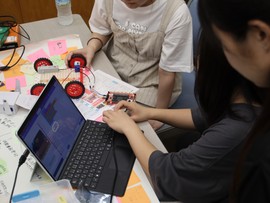
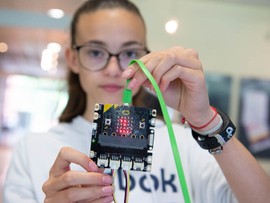
The BBC micro:bit gives children a tangible and practical way to learn about technology. The original rollout of micro:bits went to UK secondary schools back in 2016. But as technology becomes more embedded in our lives, there is a growing need to learn these skills from a younger age.
With generous financial support from Nominet, we made classroom packs of micro:bits freely available to every primary school in the UK. Partnering with BBC Children’s and Education meant that we could roll out a programme of activities to inspire and excite children to get creative with their micro:bits, by working with known entertainment brands from CBBC. As part of BBC micro:bit - the next gen campaign, we built a network of delivery and community partners to help provide localised support and training for teachers, as well as online webinars and resources.

DanTDM delivering micro:bits to a UK primary school
Photo: BBC
Sparking digital curiosity
The campaign aimed to spark digital curiosity in children aged 8-11, empower teachers with hands-on tools and training, and help close the UK’s digital skills gap recognising that today’s children won’t just use technology, they’ll shape what comes next.
New classroom packs were designed for this campaign. These included 30 micro:bits, cables, batteries, and a brand-new accessory enabling micro:bits to be attached and worn. In 2023 UK primary schools were invited to apply for a free classroom pack, which were then delivered to schools across 2023 - 2024.
The campaign launched in September 2024 with exciting news slots on BBC Breakfast, and entertainment collaborations through CBBC, on well-loved programmes such as Blue Peter, Newsround, The Dumping Ground and Football Academy. Children’s stars and influencers such as DanTDM, Maddie Moate, Tilley Lockey and Big Manny all helped explain the micro:bits to teachers and pupils across the UK, and the campaign culminated in an exciting competition with the Gladiators in 2025.

Gladiators Dynamite and Phantom, with the micro:bit Gladiators competition winners, Our Lady of Lourdes Catholic Primary
Photo: BBC
Underpinning the star-studded activities, we developed new educational resources and ran webinars targeted to new users. We worked with a network of partners to deliver professional development, training and support to schools across the four UK nations.
To reach underserved schools, we delivered a targeted campaign with support from Arm. This allowed us to discover what additional support those schools needed, such as working with curriculum providers, supporting advocate teachers and support networks, and highlighting appropriate resources.
Importantly, we also wanted to understand the long-term impact. With Dr Sue Sentance from the University of Cambridge, we embarked on a five-year longitudinal impact research project: Exploring physical computing in schools (EPICS).
Introducing machine learning with the playground survey
We also developed the BBC micro:bit playground survey, an innovative data science project, where children could use the micro:bit to investigate and gather information about their playground. This included the launch of our machine learning tool, where pupils could train and test their own machine learning model, using movement data they collected with micro:bits. Developed with the BBC and the Office for National Statistics, the project transformed playgrounds into outdoor classrooms where pupils collected, analysed, and interpreted data using the micro:bit.

BBC
Impact

They’ve all grown in confidence in the short space of time that I’ve been using them. Their excitement when they know the micro:bits are coming out is brilliant. Their digital skills have improved and their confidence has improved each week.

UK Teacher reported in EPICS Research Cambridge University
Platypus Research were engaged to conduct independent research, so we could understand the immediate effect of the campaign. They carried out quantitative and qualitative research in 3 stages through the campaign to measure impact. Findings indicated that the confidence of teachers teaching computing increased, and teachers saw other skills improve after using the micro:bit:
- 87% of teachers that recalled training resources agreed that using micro:bit had increased their confidence in teaching computing
- Over 90%of the teachers who used micro:bit intend to use it next year, with over 80% saying they would recommend it to other teachers
- 79%of teachers have seen other skills improve (e.g. logical reasoning, communication) because of children using micro:bit
- 88% of students that have been taught with micro:bit say computing and technology is more enjoyable and fun than other subjects, almost a 40% increase versus non-users
- 95%of students that had been taught with micro:bit agreed that they'd like to continue using the micro:bit in lessons
- 81% of girls who recalled being taught with micro:bit agreed they'd like a job linked to coding, compared with just 37% of those who hadn’t been taught with micro:bit
- 78%of teachers agreed that there is something in particular about micro:bit lessons that really engages their students with special educational needs and disabilities
- ALLchildren (irrespective of ability) can take part and resolve issues themselves
- 90%of young people agreed that “coding allows me to create my own ideas” after learning with micro:bit
Not only that, but early findings from the EPICS research indicate “positive implications for children’s technological self-efficacy, creativity, and digital capital”
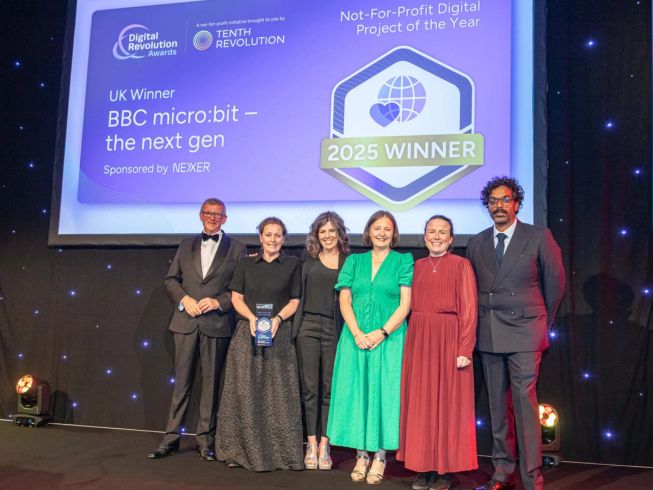
These amazing efforts were recognised by the Digital Revolution Awards as the Not-For-Profit Digital Project of the Year 2025.
Continuing the work in the UK
Over 90% of primary schools in the UK signed up for free classroom packs of micro:bits – supported by Nominet – and the project played an important role in boosting teachers’ confidence. However, we know this is just the beginning of our work in the UK. The recently announced curriculum changes following the Curriculum and Assessment Review for England highlight the importance of equipping young people with digital skills and knowledge that they need for the future.
We will continue the work that the next gen campaign started, by inspiring and supporting teachers across the UK to give children the tools, skills and understanding they need.
By continuing to work with partners across England, Scotland, Wales and Northern Ireland, and with new organisations, we will support teachers in the spaces they are familiar with. Our micro:bit Champions network will help teachers who are starting out, and empower those confident with micro:bit to support teachers in their own schools. We are committed to developing and supporting teachers and students in the UK and excited to build on lessons learned in this project to bring micro:bit inspiration to more students internationally.
The BBC micro:bit – the next gen initiative strove to ensure that every primary school student was given the tools to imagine and innovate with technology. By equipping young minds with digital skills, the campaign inspired creativity, challenge stereotypes, and nurtured a passion for learning. This innovative and ambitious campaign brought together the entertainment power of some of the BBC’s best-loved children’s brands with the hands-on fun of the micro:bit, in a truly collaborative effort.
Cerys Griffiths, Head of BBC Bitesize, BBC
The BBC micro:bit – the next gen campaign has shown what’s possible when the right technology, tools and training come together to make digital skills fun and accessible for young learners. As guardians of the .UK domain, Nominet is proud to work with partners to bring the benefits of the internet to all. Thanks to them, this programme reached 90% of UK primary schools and thousands of devices are still being used nationwide to bring digital skills to life. The Micro:bit Educational Foundation remains committed to supporting educators as they inspire the next generation with the skills and confidence they need for the future, and we’re excited to see what they create next.
Paul Fletcher, CEO, Nominet